From my buddy Ryan G, I received a first printing of the original English language edition of Barefoot Gen, Volume 1.
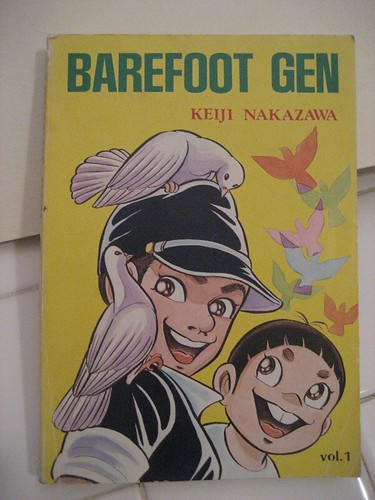
It was published in April 1978 by a group of Japanese and Americans called Project Gen. The book was adapted into English and published as a labor of love by anti-nuclear activists with an eye on promoting international disarmament and peace. This volunteer-led effort was mentioned in my interview with esteemed manga historian/translator and author, Frederik Schodt in Electric Ant Zine #1.
So.... It turns out that this was the first manga ever published in English!
From Fred Patten's Watching Anime, Reading Manga (Page 25),
"MAY 1978: The English translation of the first volume of Keiji Nakazawa's Barefoot Gen, a semi-autobiographical manga novel of a child's personal experience of the 1945 atomic bombing of Hiroshima, is published in Tokyo by Project Gen for distribution in the United States by the New York City-based War Resisters League. This is the first American edition of a translated Japanese manga."

Here is the copyright page from the book.

All of the lettering is uneven and was done by hand. In an interview for the zine, I asked Fred Schodt about the earliest manga he had worked on, and he mentioned that he and Jared Cook had worked with Project Gen on Volume 2 of Barefoot Gen, and that he believed Barefoot Gen to be the first manga translated into English.
I don't know where Ryan G. managed to track this down, but it's an exceptionally awesome find (in good condition too!) and I totally treasure it as a piece of publishing history. As most of us who've read Barefoot Gen more recently are aware, Last Gasp is the current publisher for this intense and significant series, and recently published the sixth volume, Writing The Truth.
The fine print:
BAREFOOT GEN (HADASHI NO GEN) VOL. 1
by Keiji Nakazawa
Translated and Published by Project Gen
First Printing, April 1978
Project Gen Staff:
Masahiro Oshima, Noriko Nakamoto, Libby Hopkins, Hiromi Matsuoka,Yukio Aki, Toshihide Suzuki, Akiko Sugiura, Alan Gleason, Jim Morrison, Makoto Tamaki, Machiko K. Whittaker, Etsuko Takeda, Sachiko Harada, Megumi Ito, Tamio Kaneko
Excerpt from the introduction:
What is Project Gen?
We're a group of Japanese and English-speaking non-Japanese living in Tokyo and around North America, bound together by our concern about nuclear weapons and nuclear power, and by our faith that Barefoot Gen can serve the cause of peace in other nations as it has in Japan. We are all volunteers, giving what time we can to translate, proofread, answer letters, raise funds, do the lettering and the layout work. Some of us are students, some teach, some are studying Japanese culture or were just "passing through" and stayed on; some are engaged in other projects like relief of India's cyclone victims or the problems of Japan's Korean minority. Many of us went to Hiroshima on the 32nd anniversary of the bombing in August, 1977, and participated in peace walks and workshops about nuclear energy and weaponry. Barefoot Gen has been in the works since November, 1976, when some of us first talked with author Keiji Nakazawa about translating Gen into English.
The intro also features
- a short letter by literary critic Jun Ishiko from 2/5/1978 "To the parents and children of the world" about the history of Barefoot Gen and the dangers of nuclear proliferation.
- an in-depth short article 'On "Hadashi no Gen" by Susumu Ishitani, member of the Fellowship of Reconciliation Japan, Conscientious Objection to Military Tax about their personal experience during wartime living in Japan and being exposed to the second atomic bomb in Nagasaki on August 9, 1945.They talk also about their experience as a hibakusha and the dangers of nuclear weapons.
PS: If you can think of other contenders (floppies, promotional materials, etc) that would challenge this book's status as FIRST ENGLISH MANGA, I would love to hear about it. Leave thoughts and leads in the comments!

0 comments:
Post a Comment