[As usual, RSS folks please click through to view the PictoBrowser galleries! Mouse over the gallery for captions.]
From the Amazon listing:
Enter the strange world of Imiri Sakabashira, whose denizens are zoomorphic creatures that emerge from one another as well as their equally bizarre environs. The Box Man follows its protagonists along a scooter trip through a complex landscape that oscillates between a dense city, a countryside simplified to near abstraction, and hybrids of the two; the theme of hybridity permeates throughout. One is unsurprised to encounter a creature that is half elderly man, half crab, or a flying frog in this world where our guide apparent is an anthropomorphic, mollusk-like cat. Sakabashira weaves this absurdist tale into a seamless tapestry constructed of elements as seemingly disparate as Japanese folklore, pop culture, and surrealism.Within these panels, it becomes difficult to distinguish between the animate and the inanimate, the real and the imagined—a tension that adds a layer of complexity to this near-wordless psychedelic travelogue.
Imiri Sakabashira (real name Mochizuki Katsuhiro) was born in Shizuoka, Japan, in 1964, the same year that Garo, the influential manga anthology in which he would first be published, was founded.
The Box Man is included in the story collection, Red Tights Man:
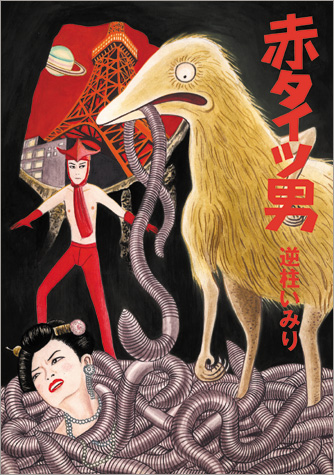
[Thanks, Anonymous!]
English edition of The Box Man:

According to Amazon, Drawn & Quarterly will also be publishing Red Snow by Susumu Katsumata on September 29, 2009. [UPDATED]: Here are 4 pages from the English edition, posted on the D&Q blog today:
From that listing:
Continuing D+Q’s groundbreaking exploration of the fascinating world of Gekiga, this collection of short stories is drawn with great delicacy and told with subtle nuance by the legendary Japanese artist Susumu Katsumata. The setting is the premodern Japanese countryside of the author’s youth, a slightlymagical world where ancestral traditions hold sway over a people in the full vigor of life, struggling to survive the harsh seasons and the difficult life of manual laborers and farmers. While the world they inhabit has faded into memory and myth, the universal fundamental emotions of the human heart prevail at the center of these tender stories.
Katsumata began publishing comic strips in the legendary avantgarde magazine Garo (which also published his contemporaries Yoshihiro Tatsumi and Yoshiharu Tsuge) in 1965 while enrolled in the Faculty of Science in Tokyo. He abandoned his studies in 1971 to become a professional comics artist, alternating the short humorous strips upon which he built his reputation with stories of a more personal nature in which he tenderly depicted the lives of peasants and farmers from his native region. In 2006, Katsumata won the 35th Japanese Cartoonists Association Award Grand Prize for Red Snow.
Japanese edition of Red Snow:

English edition of Red Snow:


0 comments:
Post a Comment