Showing posts with label Book Contributors. Show all posts

David Smith's Blog

David Smith is one of the contributors to the Thinking Animation Book and is a great animator and story teller. He gave us quite a few stories an antidotes for the book but has many of his own as well. He has started a new blog and just placed a beautiful entry about Mary Blair.

He also has some samples of his own amazing boards!
Go David! ~ Angie

Scott makes me smile

Scott Holmes is a kick ass animator working on a mocap show right now and its quite the soul crusher. So, I wanted to send a little shout out to my homie, 'cuz he makes me smile and helps me through bad days with his sarcastic wit. I asked him to draw me a giraffe on a chopper and he did...he has some other bad ass drawings on his blog So Cal Weirdo.

Scott also was the content editor for our book and didn't get paid what he was worth. He kept Jamie and I honest and I thank him for his guidance and tough love during the editing process. I can't wait til he gets his shirt line out there...I am gonna buy all of them and get my girl platoon to buy them out, as well. This is the home of his shirts Weirdo Apparel. Check it out yo!

luv ya man,
Ang


Tom Sito Podcast


Tom is a wealth of animation history and is a contributor for our book. Have a listen to this great podcast with Tom and check out his new book.


Disney Talk mp3

Per your requests, we now have the Disney Talk in an mp3 format!

We hope you can distinguish who is talking and
without the visuals and this provides a much smaller file.

Disney Talk, mp3 format (50 meg)

Original Video of Disney Talk (100 meg)

Here is the text from the handout we gave to the attendees:

Fleas on The Shoulders of Giants
Thinking Animation Panel and Book Signing
Tuesday, September 26, 2006
12-1:00 pm
Disney Feature Animation


This panel seeks to demystify, debunk, and drive the dialogue about the future of 2D and CG character animation. It is motivated by the sea change that is currently affecting our industry. The introduction of the computer has changed an art form that had been, until now, a pen and paper medium for upward of 80 years. Today, traditional animators and artists are giving up their fear of the machine and embracing CG in droves. The art of classical film animation has been ever-evolving since its early days. Artists and the studios have strived to raise the bar visually through storytelling since the first crude attempts at putting moving images on the screen.

We are talking about classical animation and its evolution into computer-generated feature films—think Steamboat Willie and its progression to The Incredibles. It is important to recognize trends in filmmaking, storytelling, and technology for an animator to increase his or her chances of continued employment. Trends and history reveal how evolution of an art form occurs. Paying close attention to the trends and growth of any field helps predict the future of that industry. Three major shifts are responsible for the progression from pencil to mouse in feature animation: aesthetic, audience, and storytelling.

Looking at the interesting turn of events in animation, many questions come to mind. What makes for a smooth transition? What has helped those who have made the jump? How much of the 2D art form is applicable to the digital realm? What have we gained and lost in the rise of CG? What is the impact of more 2D animators entering the CG industry? Without drawing as a craft threshold, is there room for a new set of animation heroes in CG with a signature style like, say, Ward Kimball’s (of Disney’s Nine Old Men fame)? This is a relatively new art in the broader sense of the word, and we are all learning as we go because we are but fleas on the shoulders of giants.


Organizers/Moderators
Tenny Chonin

Walt Disney Feature Animation

Hanna Hurme
Book Soup Sales


Angie Jones
Digital Domain


Angie Jones began her animation career at a San Diego studio with more than 150 traditional animators 12 years ago called Lightspan. Although she was trained at Atlanta College of Art in Fine Arts, she readily embraced animating with the computer. She has worked on numerous productions, including Stuart Little 2, Disney’s 50th Anniversary commercials, Oddworld: Abe’s Exodus, Garfield, Dino Crises 3, Pan's Labyrinth, Zoom, Scooby Doo Too, XMen 2, and National Treasure. You can find out more about Angie here - Spicy Cricket Animation.


Jamie Oliff
Reel FX


Jamie Oliff was trained in classical animation at Sheridan College of Art and Design and has worked in the animation industry for more than 20 years. An award-winning director and long time feature film animator, his credits include the first season of The Ren and Stimpy Show, and many feature length animated pictures such as Hunchback of Notre Dame, Mulan, Hercules, The Emperor’s New Groove, and CG animation on titles ranging from Kangaroo Jack to Scooby Doo Too and National Treasure. He lives in Burbank, CA. with his wife and two children and a biplane project that he never finds enough time to finish.

Panelists
Richard Taylor

Electronic Arts


Richard Taylor has an extensive background in live-action direction, production design, special effects, and computer-generated images for theatrical films, television commercials, and computer games. He began his career as an artist and holds a BFA in painting and drawing from the University of Utah. In 1971 Richard received The Cole Porter Fellowship to USC graduate school, where he earned his Master’s degree in photography and printmaking. In the past 30 years, Richard has lent his talent to a number of companies, resulting in many award-winning commercial spots and seven Clio awards, along with two Hugo awards and two Mobius awards. Richard was a member of the team at Magi, whose commercial for Atari’s Worm War I was the first to win a Clio for computer animation. His other commercial work includes spots for companies such as Ford, RCA, Kellogg’s, Reebok, McDonald’s, UPS, Honda, Toyota, Bud Light, Intel, Norwegian Cruise Lines, Census 2000, Warner Bros., Disney, Duracell, and 7-Up, for whom he launched the internationally acclaimed “Spot” campaign. Richard’s years in the industry have provided him with a wide array of opportunities in addition to commercial work. He has done everything from directing promotional films for major networks, to designing, supervising, and directing special effects and computer-generated images. Richard has worked in various capacities on features such as Tron, Star Trek: The Motion Picture, Looker, Something Wicked This Way Comes, and Where the Wild Things Are. Presently Richard is cinematics director at Electronic Arts Los Angeles. Over the last four years he has designed and directed cinematics for such games as Top Spin, Links 2004, Lord of the Rings: The Battle for Middle Earth 1 and II, and Command and Conquer 3.

Jerry Beck
Cartoon Brew


Jerry Beck has become one of the most knowledgeable and well-rounded animation historians ever known. His dreams of becoming a cartoonist rooted from his early childhood with cartoons such as Yogi Bear and Huckleberry Hound. Despite the fact that animators were not in demand by the time he graduated from high school, he still found a career in the field that he loved as an animation scholar. Working as an associate alongside Leonard Maltin, an experienced animation researcher, they published Maltin̢۪s book, Of Mice and Magic: A History of American Animated Cartoons in 1980. From then on, Beck would take part in various cartoon research projects, both solo and with partners such as Will Friedwald. Many of his findings on the subject are in the form of books such as The 50 Greatest Cartoons and Warner Bros. Animation Art, but he has also created television specials and has even taught several college courses on the history of cartoons, as well. In addition to being an animation historian, he is also an animation producer, and has been, and is working on creating cartoons.

Floyd Norman
Disney Publishing Group


Floyd Norman began his cartooning career while still in high school assisting Bill Woggon on the Katy Keene series for Archie Comics. He attended Art Center College of Design as an Illustrator major. Floyd started working as an animation artist for the Walt Disney studio on Sleeping Beauty and eventually graduated to the story department where he did story sketch on The Jungle Book. This was the last film Walt Disney personally supervised. Floyd wrote and produced animated segments for Sesame Street, Villa Alegre, and dozens of educational films. Also, Floyd supervised animation layout at Hanna-Barbera Productions and storyboarded several shows including The Flintstones, Smurfs, and Scooby Doo. He wrote scripts for The Quicky Koala Show, The Real Ghostbusters, and Monster Tales. Floyd returned to Disney in the early eighties to join the Disney Publishing Group. He wrote the syndicated Mickey Mouse comic strip and contributed stories for Disney Comics. As Project Supervisor in Creative Development Publishing, Floyd created, wrote and designed several children's books. After a ten year absence from film, Floyd returned to his roots doing story work on several feature length Disney animated films, Hunchback, Mulan, Tigger Movie, Dinosaur, and Toy Story 2. Intrigued by the new digital realm and interactive computer media, Floyd helped develop computer software for painting and animation. After a long and varied career, Floyd enters a new millennium more excited than ever about the possibilities of a new media. Now Floyd works with his previous associates adding his special blend of wit and whimsy to the Afro-Kids.com website.


Disney Talk


Download quicktime of Disney Talk

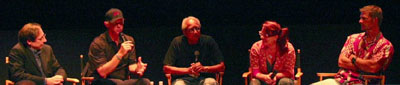
Above is a link to a quicktime movie of the talk we gave at Disney on September 26th, thanks to Tenny Chonin - Head of Artistic Development at Disney Features. The file was HUGE since the talk was one hour long, but we were able to compress it down to about 100 meg. If anyone has any better ways of compressing it more, please contact Angie.

Jamie and I owe a great thanks to Floyd Norman and Richard Taylor who both wrote forwards to our book, as well as Jerry Beck who was great help with all of the historical information in the book for taking the time to participate in our panel. Each of them added a different perspective to the talk making it balanced and comprehensive. Thanks guys so much for coming!


In case you would like to read Floyd Norman's forward to the book, click here.

And, we have posted Richard Taylor's forward below.


This book has been lovingly crafted by two talented animators who enjoy their work and recognize the value of knowing the history, the art, and the craft of animation. Jamie and Angie have pooled the knowledge of some truly talented professionals to help them convey to the artist, animator, historian, or fan the combination of technology, art, discipline, and heart that it takes to succeed as a contemporary animator. What a phenomenal time this is in the evolution of animation and film. We are surrounded daily by the most complex visual imagery that mankind has ever created; be it in print, movies, television, games, or on the Internet, our lives are bombarded daily by images of seemingly limitless complexity. Today literally any image that a filmmaker can imagine can be realized. True, some dreams cost more than others, but the fact is the tools now exist that allow the artist, the animator, and the filmmaker to create photo-real illusions, fantasy characters that entertain and amaze us in films such as Titanic, The Incredibles, Shrek, Jurassic Park, King Kong, Lord of the Rings, Harry Potter, The Matrix, Alien, Terminator, Blade Runner, Star Wars, and Tron. Films packed with astounding special effects pour out of the studios yearly and on TV weekly. The technological tools to create this imagery are logarithmically improving as they become faster, better, and cheaper annually.

Tron—interesting that I would mention that film. I was co-visual effects supervisor on the picture, which was released in 1982. Tron was the film that introduced the world to computer imaging. So I’ve been involved with computer animation since its first use in the film industry. I’ve watched as art and technology fused to create the most powerful and limitless visual tool in the history of man. Computer-generated imaging (CGI) is now the fundamental tool used in creating visual effects and animated features. If there’s one thing I’ve learned over the years, it’s that computers and software don’t create these fantastic images. A computer is analogous to a Steinway piano—it’s an instrument. It’s the artist who plays the instrument who brings it to life. So how does one become an animator who is adept at the latest technological advances, yet still creates with the spirit and freedom of traditional hand-drawn animation? This book deals directly with that query and should give you plenty of answers.


To begin with, production designers, directors, animators, and other artisans who are legendary in the film industry have several things in common. They know how to draw, they study art and the history of their craft, they hang out with their peers, they are objective, and they make an effort to learn something new every day. But the most essential thing they have in common is self-discipline. Successful artists in painting, photography, music, dance, or animation are joined in an endless dance with their art forms. They put energy into the process daily, and in return it teaches them something new. The more you work at an art process, the more it teaches you. This dance is the mother of happy mistakes and magical revelations.For those who love the art of animation and would like to make animation their life’s work, this book will reveal some basic skills and understandings. Lean to draw 2D animation. The nature of hand-drawn animation allows the animator to exaggerate the elasticity, the personality of a character. Drawing by hand creates a rhythm and flow that’s difficult to achieve in 3D work. It’s the human feeling, the personality, the heart of the animator that can be realized through drawing. Dedicated animators observe the world around them. They constantly watch the way things move; they analyze body language and know that certain gestures convey feelings and emotions. A true animator creates more than anthropomorphic characters; they can bring life, personality, humor, or emotion to anything, be it a teapot, a tree, a lamp, or a chair.


Drawing, I believe, is essential to all the arts, especially the art of animation. The structure, design, and composition of a scene, the gesture of a character, the angle of view, the location, the set, and the props are all created through drawing. Conceptual drawings, storyboard frames, and character studies all seem to start on a napkin or a scrap of paper when an artist quickly sketches an idea before it vanishes. I’m sure you’ve heard the expression, “A picture is worth a thousand words.” In filmmaking and games, thousands of dollars is more like it.


Technology has always affected the arts. Advances in technology spike the creative juices of artists, so it’s inevitable that new ideas, new images, and new animations evolve—images that I like to say “remind you of something you’ve never seen before.” If you really want to be an animator, then begin right now by reading this book. And from this moment on, begin to learn and practice the basic skills of animation and learn to observe and interpret the magic movements of life.


—Richard Taylor (www.richardtaylordesign.com)


Dan Fowler


Dan Fowler came by my cube and modeled a Redd the Clown nose for me a couple weeks ago and I am finally getting the pix up here. Dan likes to make funny noises to annoy me and repeat "hurry UPP!" to his computer all day until I lose it. He is a silly man and makes me giggle. He is also a contributor to the book and had some great stuff to say about how his background in music helped him understand rhythm in animation and timing. To learn more about Dan go here. ~Angie


George Maestri and Ido Gondelman

Jamie and Angie want to thank two very important people.

The first person is George Maestri.


George Maestri is responsible for introducing Angie to writing about animation and she is not sure if she should hit him or hug him. Seriously though, she co-wrote her first book with him in 1998. George has worked as a writer, director, and producer in both traditional and computer animation and runs a studio of his own called Rubber Bug in Hollywood. He has worked with companies like Nickelodeon, Warner Bros., Disney, and others. He was the original animation producer on the Comedy Central series South Park and was nominated for a Cable ACE Award for his writing on the Nickelodeon series Rocko's Modern Life. He has been an incredible counselor and confidante to Angie over the years and she just wanted to take a moment to recognize him here. You rock George!!! To find out more about his books click here.

Secondly, is Ido Gondelman.


We would like to thank Ido because without him, this book really wouldn't have ever been written. Angie had the idea many years ago, but never the inclination to follow through until Ido encouraged it back in 2004 when she told him about the project. Ido has since left animation and started his own clothing line with his wife called Kings of Glory. We are so proud of Ido's perseverance and journey towards his own creativity and thank him for lighting the fire in our own journey to make the book happen. Ido is one of the 50 contributing authors for the book.

Eric Goldberg


There is a great interview with Eric Goldberg on Animated-News.com
by Christian Ziebarth
12/19/2005: "A Conversation with Eric Goldberg" Interview

Eric is one of the contributors to the book and has been a major influence in my - Angie's - growth as an animator. I am ruined now after working for him, but in a good way. I toil over every single blink, finger gesture and frame of my animations. Jamie and I are very grateful for his contributions to the book.